Archive for July 14th, 2009
 Alberta can lay claim to having the first legalized casino gaming in Canada, albeit in a temporary form. In 1967 the provincial government initiated several laws that seemed to open the door to casino games even though they were forbidden by the Penal Code. In the summer, during the Edmonton Exhibition, the Silver Slipper Saloon was opened as part of the two-week celebration. The general manager of the exhibition later indicated that he had taken payoffs from the carnival company that ran the games, that is, the Silver Slipper. Amendments to the national code in 1969 helped regulate Alberta gaming. The attorney general took control over licensing charitable bingo games and raffles. In 1975, the attorney general’s office opened the door to casinos once again as it first approved a casino for a charity event supporting a summer camp. A license was then given for a casino at the Calgary Stampede. A flood of applications for casino events overwhelmed the attorney general, and he quickly created a special Gaming Control Section to regulate the gaming. Rules were set into place over the next two years. In 1981, a new Alberta gaming commission took over all licensing powers. Alberta can lay claim to having the first legalized casino gaming in Canada, albeit in a temporary form. In 1967 the provincial government initiated several laws that seemed to open the door to casino games even though they were forbidden by the Penal Code. In the summer, during the Edmonton Exhibition, the Silver Slipper Saloon was opened as part of the two-week celebration. The general manager of the exhibition later indicated that he had taken payoffs from the carnival company that ran the games, that is, the Silver Slipper. Amendments to the national code in 1969 helped regulate Alberta gaming. The attorney general took control over licensing charitable bingo games and raffles. In 1975, the attorney general’s office opened the door to casinos once again as it first approved a casino for a charity event supporting a summer camp. A license was then given for a casino at the Calgary Stampede. A flood of applications for casino events overwhelmed the attorney general, and he quickly created a special Gaming Control Section to regulate the gaming. Rules were set into place over the next two years. In 1981, a new Alberta gaming commission took over all licensing powers.
As gaming developed, Alberta adopted the model used in British Columbia. Charities could have casino events, but they had to be held in permanent facilities that were operated by private parties. In the 1990s, the number of such facilities grew to nearly a score. There are five casinos in Edmonton; four in Calgary, and others spread around the province. Until 1998 they were not allowed to have slot machine gaming, and the charities paid a fixed fee for having an event. When the government installed machines, a new revenue division based upon play was instituted. As the government owns the machines, it keeps a majority of machine revenues. Although no serious consideration is being given to the creation of large commercial casinos, proposals have been made for wide-open, large-scale casino gaming on the First Nations reserve lands.
Alberta has many other types of gambling, including all forms of pari-mutuel operations, both on-track and offtrack. Raffles and pull tabs are sold by charities. The most prevalent form of gambling, however, is found in the bars and taverns of the province. By 1999 more than 6,000 video lottery terminals were operating in 1,200 locations, producing about $300 million in revenue, which is about 70 percent of the gaming revenue produced in the province. In that year the popular machines (which provide an average gaming revenue of $50,000 a year) accounted for a per capita gaming participation of about $1,300 per adult, the largest in Canada and North America, with the exception of Nevada. Studies have also revealed that Albertans have the highest rate of problem gambling in Canada. Efforts to ban the terminals have been concerted, with local elections called in 1998 in most of the cities. Only in a few smaller cities did the voters choose to ban the machines.
<
Alaska – Gambling in America
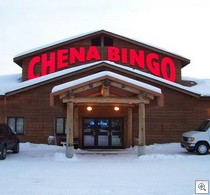 Native Alaskans and Native Americans in Alaska conduct bingo operations. There are also many bingo games sponsored by charitable organizations. Much of the revenue for the games’ sponsors comes from the sale of pull-tab tickets. Alaska permits many raffle-type games for a variety of nonprofit interests. One of the most interesting games allows people to pick the time for the first breakup of ice floes in the spring each year. In recent years there has been interest in developing some casino gambling. The proposals for increased gambling have not found support in the legislature, however, or among the general population. In 1990, a ballot initiative to permit limited stakes casino games in bars and taverns was soundly defeated by a 60 percent to 40 percent margin.
< Native Alaskans and Native Americans in Alaska conduct bingo operations. There are also many bingo games sponsored by charitable organizations. Much of the revenue for the games’ sponsors comes from the sale of pull-tab tickets. Alaska permits many raffle-type games for a variety of nonprofit interests. One of the most interesting games allows people to pick the time for the first breakup of ice floes in the spring each year. In recent years there has been interest in developing some casino gambling. The proposals for increased gambling have not found support in the legislature, however, or among the general population. In 1990, a ballot initiative to permit limited stakes casino games in bars and taverns was soundly defeated by a 60 percent to 40 percent margin.
<
 Even though Mobile, the first city of Alabama, has had a rich history of pirates, houses of ill repute, Mardi Gras celebrations, and gambling dens of inequity, most sinful activities in the state have been effectively suppressed in modern times. One major exception was the illegal enterprises of Phoenix City, which during and after World War II catered to a clientele made up mostly of soldiers from nearby Fort Benning. A major cleanup was instituted in the 1950s by state attorney general John Patterson. Patterson was propelled into the crackdown activity after his father, a candidate for attorney general at the time, was murdered by local mobsters who were running the town. In 1954 John Patterson was elected in place of his father. Even though Mobile, the first city of Alabama, has had a rich history of pirates, houses of ill repute, Mardi Gras celebrations, and gambling dens of inequity, most sinful activities in the state have been effectively suppressed in modern times. One major exception was the illegal enterprises of Phoenix City, which during and after World War II catered to a clientele made up mostly of soldiers from nearby Fort Benning. A major cleanup was instituted in the 1950s by state attorney general John Patterson. Patterson was propelled into the crackdown activity after his father, a candidate for attorney general at the time, was murdered by local mobsters who were running the town. In 1954 John Patterson was elected in place of his father.
Gambling activity resurfaced in the 1980s; however, it now operated on a legal basis—for the most part. Charitable games were permitted under the control of local governments, and the state also authorized the establishment of dog- and horse-race betting. The largest track in the state opened near Birmingham, and it pioneered an unusual event. The track featured both dog and horse racing on the same day and on the same card. The experiment with racing was not overly successful, as it was initiated just a few years before the state of Mississippi authorized commercial casino gambling as well as Native American casino gambling. Several of these facilities were near the Alabama border. Also, two other states bordering Alabama—Florida and Georgia—started very active lottery games that drew players from Alabama. The Alabama Porch Creek tribe of Native Americans led by Eddie Tullis reacted to the new gambling ventures by creating two large bingo halls and by seeking a compact for casino games. State officials refused to negotiate a casino compact, but the tribe began using gambling machines anyway.
As the twentieth century ended, the legislature gave serious consideration to legalizing new forms of gambling, including table games, and machine gambling for racetracks. There are now four dog tracks in existence, as Birmingham closed its horse-race activities. The legislature was able to authorize a public vote on the question of having a state lottery. In 1998, the governor was elected on a platform that included the lottery proposal. In October 1999, however, the voters of the state shocked not only Alabama but also the whole nation when they said no to the lottery by a vote of 54.3 percent to 45.7 percent. The lottery proposal was designed to duplicate the Georgia experience in that it designated revenues for a plan of free college scholarships for Alabama high school graduates with good records. With the negative vote, Alabama became only the second state (the other being North Dakota) to receive a negative vote on a state-operated lottery proposal.
<
Africa, the world’s largest continent, with 20 percent of the land mass of the world, includes more than fifty nation states. Almost all permit some gambling activities, lotteries, and racing, and about half allow casino gambling. Casinos in the various regions of Africa differ considerably. In the northern African Muslim countries there are limited numbers of casinos: two in Morocco, one in Tunisia, and fourteen in Egypt. Local residents of Egypt may not enter the country’s casinos, as they are specifically designed to attract foreign currency from tourists and foreign businessmen. The casinos are in major hotels; they require identification for entrance and impose dress codes. Egypt is one of the few African jurisdictions where casinos are lucrative investments.
The other area of Africa where casino gambling is attracting considerable interest is South Africa. Prior to the establishment of full democracy, the government of the Union of South Africa had a firm ban on casino gambling. That all changed in 1993 and 1994. A newly elected congress passed an act establishing lotteries and gambling. In 1996, a National Gambling Act was passed. The act created a board that was empowered to draw up rules for the creation of forty new casinos. Licensing began in 1999. Prior to the new eras of multiracial democracy, casinos had been permitted in the segregated areas known as “homelands.” The Sun City casino organization had been instrumental in establishing several casinos in the four areas that have now been integrated into South Africa under the new constitution.
East Africa has casinos that also seek to market to tourists. For instance, in Zambia there are seven casinos, with two at Victoria Falls. The other casinos are in international hotels. Kenya has twelve casinos in the capital city area of Nairobi and another nine in the coastal resort of Mombasa, all of which are quite small. There are also casinos on the tourist islands of Seychelles, Reunion, Madagascar, and Mauritius, as well as in Ethiopia, Djibouti, and Uganda. Without tourism, the casinos could not be profitable, as local populations are extremely poor.
Such is also the case with the properties in West Africa, which are found in countries such as Benin, Cameroon, Congo, Gabon, Gambia, Ghana, Liberia, Niger, and Nigeria. Senegal, Zaire, Togo, Senegal, and Sierra Leone have also had casinos, although one has to wonder how gambling activities can proceed within the atmosphere of national, political, and economic disintegration that is all too often present in some of these countries.
Casinos in very poor countries have trouble developing markets. Their ability to recruit casino staff is limited by workforce deficiencies, coupled with national rules demanding that locals be hired. These would often be locals with political connections that precluded their being properly trained or supervised and making it unthinkable that they could be disciplined if they violated the trust that must go with casino jobs. Where there are workforces in place, casino operators find that it is necessary to pay workers every day, as they might not return to work for several weeks if they received a large labor payment. A shocking sight witnessed by more than one European casino owner has been a group of local residents coming to a casino and pooling their wealth so that they could make a single pull on a slot machine handle. In Togo, the national government was so poor that it could not provide sufficient coinage to use in the operation of the slot machines. Most of the African countries between the northern Muslim region and the new South Africa state are in desperate need of economic development, but casino gambling is simply not the tool they need to establish economies that can participate in the global economy.
<
During the 1990s, Sheldon Adelson became one of the leading entrepreneurs in the gambling industry as the primary developer and owner of the Venetian Casino resort on the Las Vegas Strip.
Adelson was born in 1933 in Boston, the son of a cab driver. He worked hard and studied hard as a youth. He received a bachelor’s degree in real estate and corporate finance from the City University of New York. After a period of service in the United States Army, Adelson set upon a plan to make himself fabulously rich. He succeeded more than one time. As a venture capitalist in the 1960s, he acquired scores of companies, only to see his budding financial empire fall as the stock market took a plunge in 1969. He came back by developing a series of trade shows, the most important of which was COMDEX, the leading computer dealers’ exposition, and by the 1980s, the leading annual convention in Las Vegas each year. The success of the show led to other ventures such as developing airlines. That success also focused his attention upon Las Vegas. The convention was a gold mine for Adelson, but even Las Vegas did not have enough convention space. He privately built a facility next to the Las Vegas Convention Center and gave it to the county, realizing that his revenues from his big show would cover his capital costs in a few years. But he wanted more – his own convention center.
The Venetian Casino owned by Sheldon Adelson is the first two-billion-dollar casino property anywhere.
In the late 1980s, Sheldon Adelson was able to finance the purchase of the Sands Casino Hotel from its owner, Kirk Kerkorian. In 1989, it was licensed by the Nevada Gaming Commission, and Adelson became a casino magnate. Actually he was just holding on to the property waiting for something bigger. In 1993, he built the Sands Exposition Center, a one-million-square-foot convention facility on the Sands property. But he was still waiting for something bigger. His chance to “do something” with the Sands came in 1995 when he was able to sell the COMDEX show and sixteen other trade shows for $860 million. The next year he imploded (blew up) the Sands, and he devoted his new resources to the construction of the Venetian Hotel. The Venetian opened in April 1999 with a 113,000-square-foot casino, a shopping mall set alongside canals with gondolas, and 500,000 feet of new convention space. The hotel’s thirty-three-story tower and 3,000 rooms featured luxuries not found elsewhere. The basic room was over 700 square feet, making it the largest standard room for a hotel anywhere. The total square footage of the rooms actually exceeded that of the MGM Grand, with its 5,009 rooms. The facility had a first-phase price tag of $1.5 billion “plus.” The “plus” was the result of the fact that others paid the price. Adelson leased all the space for shops and restaurants, keeping only the casino, hotel, and meeting areas under his financial control. As the new century began, the revenues for the casino were meeting all expectations and then some, and Adelson was planning a phase-two construction of a museum and a new casino and hotel tower with 3,036 rooms adjacent to the Venetian.
|