Archive for July 18th, 2009
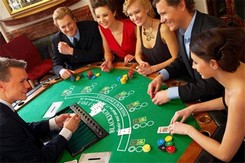 Blackjack is the most popular card game in casinos throughout the world. The game is an American creation in its present form, although it has origins in European games such as the French vingt-un (translated as “twenty-one”) and the game trente et quarante (or “thirty-one”) as well as the English game of pontoon. The form of twenty-one used in the United States was modified in 1912 when play at some card rooms in Indiana added an additional three-to-two payoff for winners who had a “natural twenty-one,” that is, a twenty-one count on their first two cards. Blackjack is the most popular card game in casinos throughout the world. The game is an American creation in its present form, although it has origins in European games such as the French vingt-un (translated as “twenty-one”) and the game trente et quarante (or “thirty-one”) as well as the English game of pontoon. The form of twenty-one used in the United States was modified in 1912 when play at some card rooms in Indiana added an additional three-to-two payoff for winners who had a “natural twenty-one,” that is, a twenty-one count on their first two cards.
The popularity of the game was greatly enhanced by the publication of Dr. Edward O. Thorpe’s book, Beat the Dealer, in 1962 (see Annotated Bibliography). The book presented solid evidence that with proper playing techniques and structures, the odds for this game can actually change and be in the favor of the player.
Blackjack is a house-banked game in which a house dealer seeks to have cards valuing 21 or a number closer to 21 (without being over 21), but higher than the values of cards held by players. The player makes an initial bet according to the house limits. A dealer gives two cards (one at a time) to each player and also takes two cards himself or herself. The blackjack table may accommodate up to seven players, each of whom individually competes with the dealer. The object of the game is to get cards totaling 21. The cards from 2 through 10 count as their number value. The jack, queen, and king each count as 10 points. An ace may count as 1 or as 11. If a hand has a value of 22 or more it is a “bust,” a losing hand for a player, and in most cases for the dealer as well. Although there are variations, in general the two player cards are dealt face up, whereas one dealer card is dealt down and one face up. The player may ask for additional cards in hopes of getting a 21, or closer to 21 than the dealer’s hand. If an extra card makes the player’s hand go to 22 or over, however, the player immediately loses the hand, regardless of what happens to the dealer’s hand. A player who is satisfied with the hand’s value and has not “busted” indicates that he or she wants no more cards. After all players are done taking cards, the dealer exposes the facedown (or hole) card. He or she takes extra cards if that total is 16 or less but stands (that is, takes no more cards) if the value of the cards is 17 or more. In some casinos, a dealer will take more cards when he or she has a value of 17, which includes an ace that is counted as an 11. (This is called hitting a soft 17).
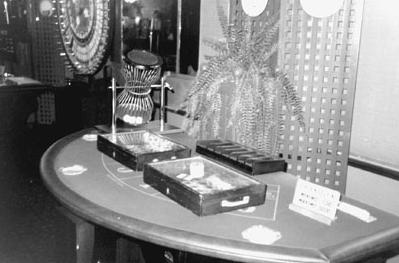
A gambling table before opening hours in a Santa Domingo casino.
Winners are paid at even money; if they bet $5, they win $5, a return of $10. If both the player and the dealer have hands with the same value, it is a tie, and the player’s bet is returned to him or her. A player who busts loses even if the dealer later busts in the same hand.
The situation is altered if the player or the dealer has a natural blackjack. A natural blackjack consists of an ace and a card valued at 10 (10, jack, queen, or king). If the player’s first two cards are a blackjack, he or she wins and is paid three to two; that is, a win of $7.50 plus $5, or a return of $12.50. This win is negated if the dealer also has a two-card blackjack, in which case the play is a tie. If the dealer has a blackjack, he or she beats all players who do not also have a blackjack. In the case of a dealer showing an ace or a 10-value card, the dealer looks at his other card; if it makes a blackjack, he or she reveals it and collects the bets from the losing players without giving them the opportunity to draw cards. If the dealer is showing an ace, however, he or she first offers all players a chance to make insurance bets, which are described later.
Certain special plays and bets are allowed to the players. For instance, if both of the player’s first two cards are the same, he or she may split them into two hands by making an equal bet on the second hand. Some casinos also allow resplitting. New Jersey casinos and many in other jurisdictions, Nevada excluded, allow the player to make a “surrender” play. After the player looks at the dealer’s one card and his or her own two cards, the player may forfeit the hand immediately for only half of the original bet. The player may also like the situation so much that he or she doubles the bet. After “doubling down,” the player may be given only one more card—if he or she desires more cards. Some casinos allow a player to double down if showing cards with values of 10 or 11. Other casinos allow any player to double down.
If the dealer is showing an ace, the player may make a bet called “insurance.” This is a side bet that does not affect the main bet on the value of the player’s and dealer’s hands. The player bets up to half of his or her original bet and wins a two-to-one payoff if the dealer reveals that he or she has a natural blackjack. With this side bet, the casino has an 8 percent edge over the player, as there are sixteen ten-valued cards (which can make the insurance bet a winner) and thirty-six other cards.
The casinos may use from one to eight decks of cards for play at blackjack. As players use strategies that may depend in part upon the cards that have already been bet (counting strategies), some players like single-deck blackjack. This is a game dealt from the dealer’s hand with both of the player’s cards being dealt face down. Most casinos shy away from single-deck games as hand dealing introduces opportunities for cheating and hence requires more monitoring. In multideck games, the cards are dealt from a shoe. A shoe is a box, usually plastic, into which the shuffled decks of cards are placed. They are dealt as the dealer slides cards from one end of the box through an opening. Shoes are also used with baccarat games and other card games.
The popularity of blackjack derives from the fact that, in addition to allowing a strategy that can give the player the edge, the game is a simple game in concept but also allows for very personal strategies. As a variety of strategies and playing styles is used by players, it is not possible to assess the odds-advantage possessed by the house (casino). In one strategy, the player seeks simply never to bust. Hence, he or she stands on any cards giving him or her a value of twelve or more, regardless of the card shown by the dealer. Under this strategy, the casino has a 6.35 percent edge over the player. If the player instead mimics the rules followed by the dealer—taking cards when he or she has a sixteen or less and holding on seventeen or more, then the casino’s edge is reduced to 5.90 percent. A more complicated, but more effective, strategy called “basic blackjack strategy” can reduce the house edge to below 1 percent, and to even, or a slight player edge, with a single-deck game. With properly executed card counting (the Thorpe strategy), the player can gain a 1 or 2 percent edge over the house.
For over four decades, Benny Binion was a local hero in Las Vegas; actually, he was a hero among the gambling community worldwide. He was the “Cowboy Gambler,” who-like his image in bronze on a horse at Second and Ogden streets in downtown Las Vegas – always rode “high in the saddle.” His casino, Binion’s Horseshoe, gained the reputation for being the “gamblers’ casino” in Las Vegas. His casino started the World Series of Poker, and his casino was the only casino that would take a “hit” for any amount of money. Here, a hit is a single bet on a single play (see Glossary). It is a bet where both sides let it all ride, one time, one spin of the wheel, and one whirl of the dice—no next time, one time. Most casinos will limit “hits” to the normal table limits—several thousands of dollars. Binion’s had no limit. The limit was what the player was willing to lay down on the table in hard cash. Hits are risky business, because the laws of probability are based upon large numbers—large numbers of bets. One time a gambler came in with a suitcase of money. He opened the suitcase and poured $777,000 on the table. He bet on “don’t pass” on the craps table. The dice rolled a few times, and the boxman called out “don’t pass wins.” The cage prepared a stack of cash worth $1,554,000, and the gambler took the money and left. If a casino that was owned by a publicly traded corporation did something so risky, a stockowner lawsuit might just be successful. But the Binion family privately held Binion’s. And maybe they were not being too risky, because the publicity they received for paying off a bet like that was also worth a whole lot of money. Actually, the same man came back and later bet $1,000,000 and lost. So in the long run, it had been good business. Three months later the man committed suicide. He was broke, but the police said he had romantic problems, too.
I did a few shots for the PBS show “Going Places: Las Vegas.” When we went into a casino on the Strip, people were crowding the cameras, waving their hands and calling out “Hi, Mom” and the like. But when we went into the Horseshoe, we shot an interview with the poker pit directly behind us. The producers did not have to make a double take, nor did they have to wait for the place to be quiet or for a distracting guest to move on. We shot the interview and not one single bettor even lifted his eyes to observe the network cameras. The bettors were more interested in the action on the table. On the Strip, the action might have been a television camera; in the Horseshoe, the action was the next card being dealt. Over the decades that Benny Binion reigned as the cowboy gambler, and when he and his wife and sons ran the casino, other gambling entrepreneurs came to Binion’s when they wanted to gamble. It was their local casino. Called the “most popular gambler” in the United States, Binion was especially popular with his fellow casino owners. He did not cater to tourists, except the hard-core gambling kind. He had no show, no music, and no two-for-one “fun book.” He did not have people out in the streets hawking the wares, trying to get the sucker in the door. His players were not suckers. He gave the best odds on the table games, offering all the options in blackjack and giving ten times odds for even bets at craps. His machines were programmed to give the largest payouts in Las Vegas—and Las Vegas gives the best payouts of any gambling city in the world.
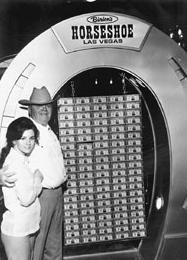 Benny Binion’s one concession to the tourists was a plastic-covered horseshoe display of one million dollars in cash; he had mounted 100 ten-thousand-dollar bills. He invited the public to come in and look and to have their picture taken with the money at no cost. When I saw that, my head began to spin numbers around, figuring that he was losing a couple hundred dollars a day just in the interest the money could be earning in a bank. But then, maybe the money was in a bank, and maybe he could not be earning the interest. The Nevada gambling regulators demand that large casinos have several millions of dollars on hand at all times in order to cover any large win that a player (perhaps with a suitcase) may have at any moment. Las Vegas builds its reputation on paying off, and the reputation could disappear quickly if there was a pattern of casinos making players wait until the “other” banks opened before they got their money. After all, when the player loses, the casino takes the money right away (well, there are credit gamblers too). The million on display may just have been part of the cage requirement, and Binion would also have been out the interest if he had had the money locked in a vault. Moreover, with the extra security (and the money was well guarded) of having the displayed million dollars, other casinos could always count on Binion’s having surplus funds. When other casinos hit a run of bad luck and their reserves fell below what the law requires, very often they would send a special security detail up to the Horseshoe to borrow a million or two, just to tide them over until the “other” banks opened. Rumor has it that Steve Wynn, as the executive of the Golden Nugget across the street from the Horseshoe, had to do just that. Benny Binion’s one concession to the tourists was a plastic-covered horseshoe display of one million dollars in cash; he had mounted 100 ten-thousand-dollar bills. He invited the public to come in and look and to have their picture taken with the money at no cost. When I saw that, my head began to spin numbers around, figuring that he was losing a couple hundred dollars a day just in the interest the money could be earning in a bank. But then, maybe the money was in a bank, and maybe he could not be earning the interest. The Nevada gambling regulators demand that large casinos have several millions of dollars on hand at all times in order to cover any large win that a player (perhaps with a suitcase) may have at any moment. Las Vegas builds its reputation on paying off, and the reputation could disappear quickly if there was a pattern of casinos making players wait until the “other” banks opened before they got their money. After all, when the player loses, the casino takes the money right away (well, there are credit gamblers too). The million on display may just have been part of the cage requirement, and Binion would also have been out the interest if he had had the money locked in a vault. Moreover, with the extra security (and the money was well guarded) of having the displayed million dollars, other casinos could always count on Binion’s having surplus funds. When other casinos hit a run of bad luck and their reserves fell below what the law requires, very often they would send a special security detail up to the Horseshoe to borrow a million or two, just to tide them over until the “other” banks opened. Rumor has it that Steve Wynn, as the executive of the Golden Nugget across the street from the Horseshoe, had to do just that.
Benny Binion was born in Pilot Point, Grayson County, Texas, in 1904. When he was fifteen years old, he dropped out of school and ran away, first to El Paso and then to Dallas. He got a job in the St. George Hotel, and there he learned about gambling. When in his later years he was asked if he would do it again, he said yes, he would have had to become a gambler: “What else could an uneducated person do?” Dallas was a wide-open town, a place of opportunity. At age twenty-two, Benny opened a casino game at the Southland Hotel, and two years later he established a leadership role in the Dallas numbers games. Things in Dallas were rough, and the competition could be tough. Although the government tolerated games for a price (he paid ten dollars a gambler to the politicians in order to stay open), others wanted him closed. In two separate instances he was in gun battles over just who would stay open; he survived. Two others died and were never able to spin the wheels of fortune again. One of those times Binion received a suspended sentence; he was acquitted on grounds of self-defense the other time. During World War II he bought a casino in Fort Worth, but its time was limited. There was a crackdown on Texas gambling after the war. There had been twenty-seven casinos in the Dallas area during the war, and some felt they could stay and try to ride it out until another election could bring the right people to office. Binion did not; he packed up his family in 1946 and went to Las Vegas.
In Las Vegas, Benny Binion opened a casino on Fremont Street along with Kell Houssels, a man who was actively involved in many casinos. As time went on, however, Binion felt that he was being restricted on doing things the way he wanted to do things. Houssells did not like the idea of allowing the players to have high limits. Some professional operators figure that with high limits, the players can use a system called the Martingale, which allows them to keep doubling their bets when they lose, and eventually they will win. But Binion knew (and it was a risk as to when) that streaks or runs of a wheel on black or red, odd or even very often can go five, six, seven, or more in length. Increasing the odds only allows one or two more bets against a fate of losing.
Binion broke up the partnership, and in 1951 he bought the Apache Hotel, renaming it Binion’s Horseshoe. His limits became the highest limits in town. On one occasion the Mob leaders at the Flamingo did persuade Binion that he should not try to compete with them too vigorously, and Binion lowered his keno limit for a while.
Binion’s problems with the law did not end when he came to Las Vegas. In the mid-1950s, he was convicted of income tax evasion and served forty-two months in a federal prison. When he was released in 1957, the state of Nevada suspended his casino license, and management of the Horseshoe was given to his wife and his son Jack. Jack carried on the tradition of Benny Binion when he established the World Series of Poker in 1969. The tournament has grown considerably since that time. All players must put up $10,000 to enter. The winner collects a million dollars. Amateurs from every corner of the globe come to compete with the most professional of all gamblers. I was in Birmingham, England, touring casinos, when I came upon the Rainbow. There I found a big sign and a program for Binion’s World Series. The casino ran the British Poker Championship, and the first prize was an all-expense paid trip to Las Vegas with the stakes to enter Binion’s World Series.
On 1 June 1988, the Horseshoe empire spread out a bit, and the Binion family purchased the next-door Mint Casino from the Del Webb estate for $27 million. The Horseshoe casino expanded its gambling area and also gained 300 hotel rooms. Previously, the Horseshoe had fewer than 100 rooms. The Horseshoe also took over the restaurant at the top of the Mint, and it became the Steakhouse. There the finest beef, nurtured on Binion’s Montana ranch, was served. The casino was also able to expand its complimentary services with the larger facility. Over one-million-dollars worth of free food was given to selected players each month. Rarely did the casino charge a full price room rate. Most rooms were frequently occupied by very good players.
On Christmas Day 1989, Benny Binion went on to “cowboy heaven,” and he left his family in charge of the gambling on Fremont Street. Jack Binion, who was born in 1937, carried on. He also branched out, establishing the number-one riverboat casino in Louisiana and then the number-one revenue-producing casino in Tunica, Mississippi. He has since become a partner in an Illinois riverboat. Family fights consumed the business after Benny’s wife, Teddy, died in 1994. Jack’s brother, Ted, was involved with substance abuse problems and lost his casino license. He later died suspiciously, murdered by a former girl friend and her new boyfriend, who were seeking Ted’s wealth. According to the Las Vegas Review Journal of 20 May 2000, the couple was tried and convicted of the murder in 2000. Two sisters fought Jack over control of the casino, and finally Jack sold the property to one of his sisters and devoted his full attention to gambling interests in the Mississippi Valley. The legend of the “cowboy gambler” is still found in Las Vegas under the canopy of the Fremont Street Experience.
<
|