Most forms of legalized gambling are permitted in British Columbia, Canada’s westernmost province. Pari-mutuel racing was permitted before the Canadian Penal Code was amended in 1969. Now telephone betting, offtrack betting, and intertrack betting are allowed for gamblers. At first, lottery games were conducted under the auspices of the Western Canadian Lottery Corporation, but British Columbia established its own independent lottery organization in 1985. The province has permitted bingo and raffle events for charities since 1970. Charities have been permitted to conduct casino events since 1978.
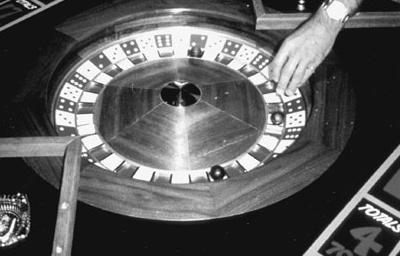
The “dice” wheel in a British Columbia casino. Dice were not allowed in Canada until 1999.
The casino events grew quickly in number and volume of activity. In 1984, the province issued regulations that governed private companies that were offering casino management services for
charities. The charities were restricted in their ability to pay staff to operate games, but the management companies could do so. Gradually a pattern emerged of having casino events all located in permanent casino facilities that were privately owned. There are now seventeen such casino buildings. Most are in Vancouver and its suburbs. The private companies are permitted to keep 40 percent of the gaming profits from a casino event of two days; the charity gets 50 percent and the government 10 percent. The private company pays the salaries of dealers and other gaming personnel, as well as all other costs. The charity only provides personnel to watch the cage.
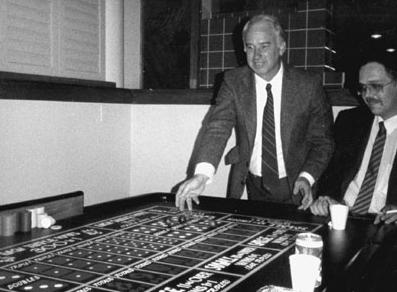
In British Columbia casino dice games were played by rolling balls. The editor makes his play.
Initially, the casinos could offer only table games, with roulette and blackjack being the most popular. In 1997, the casinos were allowed to install up to 300 slot machines each under a new revenue-sharing formula. Technically, the government owns all the slot machines.
Until national law removed the ban on dice games in 1999, the casinos had unique devices for sic bow, a three-dice game. The player rolled three balls into a roulette wheel that had thirty-six slots representing face-sides of the dice. Craps and sic bow are now played with actual dice.
For many years, there have been top-level discussions regarding the introduction of destination-type casino resorts. In the early 1990s, a plan to have the Mirage resorts of Las Vegas build a casino on the Vancouver waterfront was advanced by the premier of the province. Another plan called for a casino at the Whistler Ski Resort north of Vancouver. When the plans were announced publicly, there was a major outcry of protests from several citizen groups. The premier backed down, but the idea of having major casinos is still a matter of conversation in the province.
In 1997, the government, without sites being designated, again initiated a local option plan for twenty-one larger casinos. The First Nations of the province, however, were supposed to be given thirteen sites on their reserves. In the process of jockeying with persons wishing to control sites, the premier was forced to resign in 1999 when he was exposed for having taken favors from some of the applicants for site licenses. Also in 1999, slot machines were permitted in the charity casinos under local option. Additionally, a casino boat was permitted to operate off a dock in New Westminster.
 Brazil is by far the largest country in Latin America, with a land mass larger than that of the forty-eight contiguous states of the United States and a population approaching 180 million. The country boasts two of the largest cities in the hemisphere: Rio de Janeiro and Sao Paulo.