Casino – Gambling in America
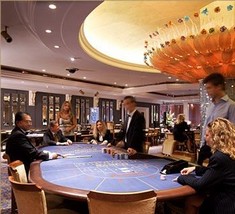 A casino is a singular location where gambling games are played. The word casino can be modified with many adjectives narrowing its scope. In this encyclopedia, attention is focused upon government-recognized or legal casinos, ones authorized by law, and ones that share their revenues with public treasuries through commission fees or taxation. Casinos considered here also have permanence. They are places where games are played on a regular basis as distinguished from places that offer only occasional gambling events, such as Las Vegas Nights. A casino operation is also one in which the house establishment is an active participant in the games. It participates as a player (e.g., in house-banked games), or it conducts player-banked games by furnishing house dealers and using house equipment. Again, a casino is more than a mere place where independent players can conduct their own games, as they did, for instance, on Mississippi riverboats in the nineteenth century.
A person studying gambling casinos as I have done over the past twenty years must be wary of other uses of the word casino. In a generic sense, the word casino means “a small house” (from the Italian casa, meaning “house,” and ino, meaning “small”) or room in a house that is “used for social amusement” (according to the tenth edition of Merriam Webster’s Collegiate Dictionary). From other dictionaries, we can find casinos identified as “Italian summer villas,” “brothels,” and “social clubs.” The word also means “dancehall.” The large casino on the southern California resort island of Catalina is a movie house. I made several inquiries in Santiago, Chile, in search of a regulatory authority for gambling “casinos.” Admittedly, I had trouble with the Spanish language, but I had the word pronunciation down perfectly. In any event, I kept being referred from one government office to another. At the end of my journey, I found myself in offices outside a large cafeteria for government employees. Indeed, I had found the “national casino”.
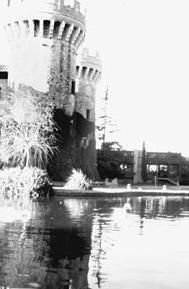
The Perelada Casino in Catyluna Spain. The casino has been built into a fourteenth-century castle.
In order to distinguish their gambling casinos from other casinos, the Spanish (of Spain) call their casinos casinos de juegos or “casinos of games.” In Germany, the gambling casinos are called Spielbanken (“play banks”). (Perhaps too many had been getting requests from visitors from Italy for certain nongambling services).
A real casino should have some distinction from places that merely have a side room for games within a larger establishment devoted to other activities. The Las Vegas Supermarket casino is really a supermarket with machine gambling; in smaller stores with machines, the machines can provide the dominant flows of revenue for the establishment. The gambling area that is a casino is a focal point for social activity wherever it is located.
The first gambling casinos appeared in ancient historical times, probably across the vast Eurasian land mass. The record of Asian gambling halls of the distant past is rather incomplete. It is known, however, that Greeks and Romans of the privileged classes traveled to beach resorts or resorts that were adjacent to natural spas and mineral waters with health-giving powers. Today’s casino resorts at Spa, Bad Aachen, and Trier were also Roman gambling centers. Roman authorities actually taxed the wagering activity of these resorts. During the Middle Ages, gambling flourished at these same places and also at houses for overnight stays along the roads traveled by the commercial and the privileged elites.
Venice became one of the first sites for a government-authorized casino in the 1600s. In 1626, the government gave permission for the Il Ridotto (the Redoubt) to have games, provided it paid a tax on its winnings. Part of the rationale for granting what was at first a monopoly casino franchise was the fact that the government was having a hard time controlling many private operators. It was hoped that they would lose their patrons to the “legal” house. The Il Ridotto then did what many “high-roller” houses do now—it protected the privacy of the players. Indeed, the players all wore carnival masks as they made their wagers. Unfortunately, this practice allowed many cheats to ply their trades without fear of easy discovery. The Spa casino in present-day Belgium reopened in the early eighteenth century, as did casinos at Bad Ems, Weisbaden, Bad Kissingen, and Baden Baden. Organized play at various houses near the
Palais Royal in Paris also flourished. The nineteenth century saw a great proliferation of casinos across Europe. The most prominent developers of the century were the Blanc Brothers, Louis and Francois. They started games at the Palais Royal and then moved to Bad Homburg, where they managed the house until the Prussian government banned gambling in the 1850s. The Blancs followed opportunity and accepted an invitation to take over a failing facility in Monaco, and they developed it into what is even today the world’s most famous casino, the one at Monte Carlo.

The New Caesar’s Tower on the Las Vegas Strip.
The entry on European casinos (see The European Casino) provides a look at reasons why European gambling failed to maintain a leadership role in world gambling into the twentieth century. The 1900s instead saw the central interest in casino gambling shift to the Western Hemisphere and especially the United States. Illegal houses in cities and resorts such as Richard Canfield’s first drew attention, and then Nevada came on the scene, where Las Vegas has come to dominate the world casino scene for more than fifty years.
European halls remain, and many newer major casinos have come to be established in a large number of the countries of the world; however, the model – the yardstick - for analyzing all casinos in the world today is found in Las Vegas. (It may be that I have a parochial bias toward the “hometown” that I have adopted, along with 90 percent of the other local residents!)
There is a wide variety of casinos in Las Vegas. They cover just about all the types of casinos found on the world scene, save the exclusive private membership casinos of England and some European jurisdictions. The Las Vegas casinos must all be open to the public, and no admission charges are permitted at the doors to the gambling rooms—indeed, if you could find such doors they would be open all of the time. There are several categories of casinos in Las Vegas. First, there is the major resort hotel casino that caters to patrons from all over the world. Some of these properties include the Bellagio, Mandalay Bay, Caesars Palace, Flamingo Hilton, Mirage, and the MGM Grand. Second, some resort hotels seek convention business from business personnel. Two such major properties are the Venetian and the Las Vegas Hilton. A third category consists of other Strip casinos that market more to a middle-class crowd that seeks a reasonably priced (even low-cost) resort vacation with all the trappings of gambling and Las Vegas sights. The Imperial Palace, Ballys, Riviera, and Sahara fill this bill, as well as the Excalibur and the Circus Circus, two establishments that have made a success out of niche marketing to vacationers who want to bring their children with them (see the section “The Family that Gambles Together” in Appendix A). Fourth, there are several smaller downtown casinos, including the Union Plaza and Lady Luck, that appeal to a drive-in audience from California and Arizona, and they keep the customers coming back with low-cost facilities. Fifth, the California Hotel focuses its marketing efforts on Asian-Americans, especially those living in Hawaii.
On the edge of the city and in the suburbs there is a genre of casinos that seek the patronage of local residents. They have very large gambling floors, but not many hotel rooms (they have to meet a minimum requirement of 200 or 300 rooms). They emphasize machine gambling and bingo. They offer good food at low prices, as well as movie theaters, bowling alleys, dance floors, and even ice rinks; anything that will keep the people coming back. Many rely on construction workers and senior citizens to keep them going. They actually run buses to senior living centers. Then there are smaller slot joints and a very wide array of bars and taverns that rely on the money from machine gambling (they are allowed fifteen machines) in order to be profitable. Convenience stores, liquor stores, drug stores, restaurants, and even grocery stores also have machines, although it would be somewhat of a stretch to call these places casinos. They do, however, come close to matching the atmosphere of some of the casinos in the small towns of Colorado and in Deadwood, South Dakota.
There are Native American casinos on the periphery of Las Vegas. Across the country the Native American casinos and the riverboat casinos mimic the types of casinos in Las Vegas. Most of them are similar to the casinos that go after the local residents. They also expect their patrons to drive to the casinos many times for repeat visits. A few may seek to become vacation resorts, but it so rarely happens that none come to mind. As California tribes develop their casinos under the provisions of Proposition 1A, however, many will strive to become resort properties where guests spend more than one day at play. This might occur in some selected locations such as Palm Springs. For the reasonably near future, however, the big casino-hotel resorts offering full vacation opportunities will continue to be found in Las Vegas and other Nevada sites, such as Reno and Lake Tahoe.