Archive for August 7th, 2009
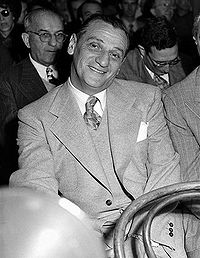 Morris Dalitz started his career in the shadows of the law, but as that career unraveled in Las Vegas, his life became one of community development and philanthropy. More than any other of the “founding fathers” of Las Vegas, Moe Dalitz converted a questionable past into an honored status as a community icon. Morris Dalitz started his career in the shadows of the law, but as that career unraveled in Las Vegas, his life became one of community development and philanthropy. More than any other of the “founding fathers” of Las Vegas, Moe Dalitz converted a questionable past into an honored status as a community icon.
Morris “Moe” Barney Dalitz was born on 24 December 1899 in Boston, Massachusetts. When Moe was very young, his family moved to Michigan. There his father started Varsity Laundry near the University of Michigan campus. The laundry business expanded, and soon the Michigan Industrial Laundry in Detroit was in son Moe Dalitz’s control. The laundry had certain symbiotic relationships that opened doors for Dalitz’s new business interests. When Prohibition descended upon the nation, bootleggers needed delivery mechanisms. Dalitz had trucks. The laundry trucks served customers at hotels and could also be put onto barges that could be transported across the waters of the Detroit River, Lake St. Clair, Lake Huron, and Lake Erie from Canada. One of the favorite places of entry for liquor as it came from Canada to the bootleggers in the United States was the point where Mayfield Road near Cleveland ended at the shores of Lake Erie. Dalitz became the leader of a group called the Mayfield Road Gang operating in Cleveland, Detroit, and Ann Arbor.
Moe Dalitz continued from the earliest days of his bootlegging activities to take the profits and convert them into legitimate businesses: more laundry businesses, the Detroit Steel Company, and even a railroad. He also had his eye out for what his liquor customers wanted, especially when Prohibition ended. He concluded that gambling was a natural business for a follow-up. Dalitz became a principal owner for several illegal casinos throughout the Midwest, including several in Cleveland and northern Kentucky.
Moe Dalitz was too old to be drafted when the United States entered World War II. He had a strong sense of obligation, however, and he enlisted as a private. His business acumen landed him in the quartermaster corps, when he received a commission. He served stateside running army laundry services. His assignment allowed him to keep in touch with his private investments.
Moe Dalitz remained active in the Detroit laundry business into the 1950s. Inevitably, he came face-to-face with Jimmy Hoffa in negotiations with the International Brotherhood of Teamsters (the Teamsters’ union). At first it appeared that there would be a monumental confrontation, with both sides calling out their “muscle” to make their position stronger. But their cooler heads prevailed as they found that mutual benefits could flow from friendly relationships. Later, Hoffa negotiated major loans for several Dalitz gambling projects and for other things as well. The first Teamsters’ loan to Las Vegas went to Dalitz so that he could finance Sunrise Hospital. Later loans also financed the Winterwood Golf Course, the Las Vegas Country Club, and Boulevard Mall – the largest shopping center in Nevada, even today.
Dalitz had come to Las Vegas in the aftermath of the crackdowns on illegal gambling that had been prompted by the Kefauver investigations. Dalitz himself was a witness in front of the Kefauver Committee. When asked if he had made money bootlegging, he told Senator Kefauver that he had not inherited his money, and “if you people wouldn’t have drunk it, I wouldn’t have bootlegged it”.
In the 1950s, Dalitz had had to choose between Las Vegas and Havana, and after trying Cuba, he decided to leave that territory to his friend Meyer Lansky. In actuality, Fidel Castro’s takeover of the island ended Dalitz’s thoughts about Havana casinos. If he had pursued the Havana idea, the Nevada gambling regulators would have informed him that no Nevada casino license holder could have a casino interest elsewhere.
The leaders of organized crime families in the United States had declared Las Vegas an “open city” after Benjamin Siegel finished his Flamingo in 1946. This meant that groups of entrepreneurs, such as those with whom Dalitz was associated, were welcome to come into Las Vegas and compete alongside Meyer Lansky, Lucky Luciano, Frank Costello, and other eastern Mob leaders. The Dalitz group found its opportunity on the Strip with Wilbur Clark’s Desert Inn Resort. Clark had gathered resources for his “dream” in 1947, but he was way short of what he needed. Dalitz and his Cleveland group made Clark an offer he “couldn’t refuse”. Clark gave up 74 percent of the ownership (that is, majority control) in return for seeing the project with his name still on it. Later the name was dropped. Dalitz added a special touch that changed marketing approaches for casinos in the future. He added a championship golf course next to the Desert Inn. Then he created a major tournament on the Professional Golf Association’s tour: the Tournament of Champions in which only winners of other tour events could compete.
In 1955 Tony Cornero died. This West Coast crime figure had made his name running casino ships off the coast of California until authorities such as Gov. Earl Warren closed down the gambling. Cornero moved to Las Vegas and started the Stardust. When he died, the remaining ownership group was very scattered and lacked the funds to complete the project. Dalitz moved in and secured a loan from Jimmy Hoffa’s Teamsters union and finished the job. He took control of management when the property opened in 1958. The Stardust added a golf course with another Champions Tournament. The casinos increased the glitz level of the Las Vegas Strip by having the largest and most noticeable sign. The Stardust also brought in the Lido Show from Paris, which featured a chorus line of fifty well-costumed but still topless showgirls.
Moe Dalitz’s interests also went to downtown Las Vegas, where he bought and sold the Fremont and also constructed the Sundance (now the Fitzgerald), which was the tallest building in the state for many years. His investment in a California resort called Rancho La Costa brought a lot of attention, as he again used Teamsters’ loans and his partners were people with questionable backgrounds. Dalitz sued Penthouse magazine for writing a very critical article about his participation with mobsters. He lost the suit, but the Nevada Gaming Commission began to examine the question of whether or not he should hold casino licenses. He had by this time already sold the Desert Inn, and he sold other casino interests as well, keeping the properties and leasing them to the holders of the gambling licenses. He became content to be an elder statesman for Las Vegas. Other business interests satisfied all his financial needs, and his many charities made him a leading citizen.
Moe Dalitz had organized a group of casino owners in the mid-1960s to develop a strategy to make casinos more legitimate in the eyes of the power holders in the state. The Nevada Resorts Association was established as a lobbying arm of the casinos. One of their first projects was to support the creation of a hotel school at the new University of Nevada, Las Vegas. In personal actions Dalitz gave additional contributions to the new university to furnish its first building—Maude Frazier Hall. He was also a major contributor to many charities. His money was instrumental in starting a major temple for his faith. He was named Humanitarian of the Year by the American Cancer Society and in 1982 received an award from the Anti Defamation League of B’nai B’rith. When he died on 31 August 1989, he had completed the transition from being an outlaw businessman to being the most respected citizen of his city.
Dalitz’s career had a very personal impact on my life. I grew up in Ann Arbor, Michigan, where my family patronized the Varsity Laundry started by Moe Dalitz’s father. Neighbors’ houses were sold by Dalitz Realty. I never heard that name again until I moved to Las Vegas in 1980. When my father visited me, he asked if there was a Moe Dalitz in Las Vegas, and I replied that yes, he was one of the founders of the Las Vegas Strip. My father then related that he had played cards with Moe’s father, Barney, in the 1920s and that they had lived just two blocks away from us on Granger Street. In the late 1980s I went to Ohio to study a campaign for casinos in Lorain, near Cleveland. As I drove off the interstate highway into town, I noticed the name of the road was Mayfield Road, famous from Prohibition days. I had come to another spot in Moe Dalitz’s career. Now in Las Vegas I shop at the Boulevard Mall; one year my boys went to the school at Temple Beth Shalom; I visited the emergency room at Sunrise Hospital when the kids needed a stitch or two; I walk by Frazier Hall on the University of Nevada, Las Vegas, campus five days a week – all places associated with Dalitz. My office is in the building that houses the Hotel College. On occasion I have had the pleasure of dining at the Las Vegas Country Club as a guest of one “important” person or another. I feel that the shadow of Moe Dalitz has covered many of my footsteps.
<
 During the 1950s, Cuba offered the gambler several of the leading casino facilities in the world. There was little doubt, however, that the gaming was connected to organized crime personalities in the United States as well as to military dictator Fulgencio Batista, and both entities skimmed considerable sums from the operations. Cuba also had both public and private lotteries, a first-class racing facility, and jai alai fontons. All the gambling activity came to a halt after Fidel Castro engineered a successful rebellion and took over the reins of power in January 1959. Repeated attempts to negotiate a continuation of casino gaming were unsuccessful, and it has been suggested that U.S. crime interests were involved in attempts to overthrow the Castro regime, both in the abortive Bay of Pigs invasion and in several assassination attempts on the new dictator’s life. The entire tourism infrastructure has slipped into decay during the four decades of Castro rule. Today there are voices suggesting that Cuba may seek to restore its tourism industry and may even contemplate reopening casinos. During the 1950s, Cuba offered the gambler several of the leading casino facilities in the world. There was little doubt, however, that the gaming was connected to organized crime personalities in the United States as well as to military dictator Fulgencio Batista, and both entities skimmed considerable sums from the operations. Cuba also had both public and private lotteries, a first-class racing facility, and jai alai fontons. All the gambling activity came to a halt after Fidel Castro engineered a successful rebellion and took over the reins of power in January 1959. Repeated attempts to negotiate a continuation of casino gaming were unsuccessful, and it has been suggested that U.S. crime interests were involved in attempts to overthrow the Castro regime, both in the abortive Bay of Pigs invasion and in several assassination attempts on the new dictator’s life. The entire tourism infrastructure has slipped into decay during the four decades of Castro rule. Today there are voices suggesting that Cuba may seek to restore its tourism industry and may even contemplate reopening casinos.
The island of Cuba was colonized and controlled by the Spanish government for four centuries, until a revolution developed to a major scale in the 1890s. When the United States declared war on Spain in 1898, the revolution became successful, and independence was gained for the Cuban people. Authorities in the United States, however, sought to keep many controls over the Cuban people. War troops were not removed until 1902, and even after the Cubans elected a new government under President Jose Miguel Gomez that year, the United States “negotiated” to have a major naval base at Guantanamo Bay. Other commercial interests in the United States also maintained an economic domination over much of Cuba, but these interests had been in Cuba for many years before the revolution. Many Americans looked at the seaside location called Marianao, ten miles outside of Havana, and found it to be a desirable place to live, engage in real estate transactions, and start tourism resorts.
A local group known as the 3 C’s (named for Carlos Miguel de Cespedes, Jose Manuel Cortina, and Carlos Manuel de la Cruz) formed a tourism company that sought to build a casino in Marianao. In 1910, they proposed legislation in the National Congress that would permit the casino and would also grant them an exclusive thirty-year concession to operate it. At a time when the Americans in Cuba saw the casino as “opportunity”, Americans in the United States were in a wave of anti-sin social reform. This was the same year that the casinos of Nevada closed their doors and the Prohibition movement was in high gear. U.S. president Howard Taft was lobbied hard by church interests to not allow gambling so close to our shores. During the Spanish American War, President William McKinley had decreed that there be no more bullfighting in Cuba, calling the activity a disgraceful outrage. Taft was expected to bully the Cuban Congress to follow U.S. wishes as well. The legislation failed to pass. A second attempt was made to have casino-tied revenues to support $1.5 million in construction of facilities for tourism in Marianao. One New Yorker, who had a contract to build a jai alai fonton and a grandstand for racing, sought to change Taft’s mind on the issue, but again, casinos were defeated as a result of a moralist campaign in the United States.
Gambling was in the cards for Cuba, however. In 1915, Havana’s Oriental Park opened for horse racing. In 1919, the casino promoters promised that they would build the streets and plazas for Marianao if they could have casinos. President Mario Menocal, who had been elected in 1917, supported a bill for casinos. The national legislature authorized a gambling hall for the resort on 5 August 1919. The 3 C’s group ran the facility. In addition to land improvements for tourism, they agreed to a national tax that was designated for the health and welfare of poor mothers and their children. At the same time, President Menocal’s family won the concession to have jai alai games in Marianao. The tourism push was on, and the United States was the primary market, especially after Prohibition began for the whole country in 1919. The Roaring Twenties roared outside of Havana. Several new luxurious hotels opened, each having a gaming room. Each successive presidency endorsed tourism and welcomed all investors. Even Al Capone opened a pool hall in Marianao in 1928. Then the Depression came.
The 1930s in Cuba were years of reform thinking. Leaders openly condemned the degradation of casino gaming and other sin activities that had been widely offered to tourists. In 1933, the casinos were closed, and Prohibition ended in the United States. The economy floundered. The next year, army sergeant Fulgencio Batista was able to oust President Ramon Grau San Martin and install his own government. He ruled as chief of staff of the army while another held the presidency. At first Batista tried to bolster the notion of cultural tourism, but he could not resist allowing casinos to reopen—under the control of the military. Batista was very concerned about the honesty of the games. For sure, he would be skimming. If players were being cheated, however, there soon would be no players. The house odds could give the casinos enough profits to pay off the generals and the politicians, but not enough to pay off all of the dealers. Games had to be honest. He turned to a person who understood this and other dynamics of the casino industry very well – Meyer Lansky. Lansky took over casino operations, and he imported dealers who would work for him and not behind his back. The Mob cleaned things up. Because of World War II and postwar disincentives for foreign travel by Americans, however, the casino activity was rather dormant through the 1940s. Nonetheless, Havana attracted more persons of bad reputation. In 1946, Salvatore “Lucky” Luciano moved in to conduct heroin trade and to be involved with the Jockey Club and the Casino Nacional. Lansky was influential in persuading the government to expel his competitor.
Fulgencio Batista won the presidency on his own in 1940. In 1944 and 1948, he permitted Grau San Martin and Carlos Prio Socarras to win open elections; however, he remained very much a controlling element. In 1952, while a candidate for the presidency, he sensed he had no chance of victory. Batista executed a coup and took the reins of power. Subsequent elections were rigged, and he remained in power until the beginning of 1959. During this latter period of rule, casino development accelerated.
The 1950s started out slowly for the casinos. Prior to 1950, only five casinos were in operation, and a brief reform spirit in 1950 led the government to close them. Commercial pressures, however, led to a reopening before Batista conducted his coup. The casinos now offered large numbers of slot machines for play. By the mid-decade, new Cuban hotels were attracting large investments from the United States, as the gambling operations were quite lucrative. Foreign operators, however, still had ties to organized crime members. A major incentive for a renewed interest in Cuban gaming came from the Senate Kefauver investigations that were exposing illegal gambling operations in the United States. Organized crime members were being run out of places such as Newport, Kentucky; Hot Springs, Arkansas; and New Orleans, Louisiana. At first, they gravitated toward Las Vegas; then Nevada instituted licensing requirements that precluded their participation in operations there. Cuba, the Bahamas, and Haiti became desired locations. Four of the five largest Havana casinos were in the hands of U.S. mobsters. As newer properties such as the Havana Hilton, the Riviera, Hotel Capri, and the Intercontinental Hotel came on line, Mob hands were involved in the action. Meyer Lansky was always the leader of the group. He kept the games honest, and he kept the political skim money flowing in the correct directions. When someone got out of line, he gave the word, and Batista could make a great show about throwing a mobster out of the country. In addition to enhancing casino gambling, Batista also improved revenues of the national lottery by inaugurating daily games.
In 1958, things seemed to be on a roll just when Fidel Castro gathered strength for his military takeover. Revelations in the New York Times about Mob involvement in Cuban casinos dampened tourist enthusiasm, as did the fear of impending violence. The names of Jake Lansky, Salvatore Trafficante, and Joseph Silesi were added to the lists of unsavory participants in the industry.
Fidel Castro was born in 1926, the son of an affluent sugarcane planter. He attended a Catholic school in Santiago de Cuba before entering the University of Havana as a law student in 1945. There he began his career as a political activist and revolutionary. He participated in an attempt to overthrow the government of Dominican Republic strongman Rafael Trujillo and disrupted an international meeting of the American states in Bogota in 1948. He sought a peaceful way to power in 1952 as he ran for Congress; however, the contest was voided as Batista seized power and cancelled the election. In 1953, Castro took part in an unsuccessful raid on the government; he was captured and imprisoned for a year. He was released by Batista as part of a general amnesty program but kept up his revolutionary efforts, leading another unsuccessful raid in 1956. His third try was his charm, as he successfully moved through rural Cuba during 1958, attacking Havana at the end of the year and driving Batista from office.
When Castro’s forces descended on Havana on New Year’s Eve 1958, there were thirteen casinos in Havana. The hotel casinos represented a collective investment of tens of millions of dollars. Lansky’s Riviera alone cost $14 million. Owners and operators did not want to join Batista in his hasty exile out of the country, even after revolutionary rioters had smashed up many of their gaming rooms. They wanted to hold on to what had been a very good thing. That would be difficult, however. Castro had waged a revolutionary media campaign that condemned the sin industries of Cuba and their connections to the Batista government. Castro had pledged that he would close down the casinos.
Castro was true to his word on this score, at least at the beginning. He also stopped the national lottery from operating. Meyer Lansky, on the other hand, pledged that he would work with the new government, and casinos were temporarily reopened, ostensibly to protect the jobs of their 4,000 workers. The reopenings were short-lived, however. The casinos closed for good (under the Castro regime) in late 1960. Castro’s frontal attack on the Mob and its casino interests in Havana had political consequences in the United States, where the Central Intelligence Agency planned the 1961 Bay of Pigs invasion to overthrow Castro and also may have contracted with organized crime operatives to attempt to assassinate the new leader.
The fall of the Batista regime and the end of Cuban casinos had repercussions throughout the gaming industry. Nevada lost its strongest competitive market, and Cuban operatives and owners had to move. The ones that could be licensed went to Las Vegas, as did many of the dealers and other casino workers. Others had to find unregulated or underregulated jurisdictions. Haiti and the Dominican Republic were close at hand, as were the Bahamas. Most of the gaming entrepreneurs in these jurisdictions had Cuban experiences, as did many who went to London to open casinos after 1960 legislation gave unregulated charity gaming halls a green light. Lansky, George Raft, and Dino Cellini were principals in London’s Colony Club until they were expelled from the country. Former Nevada lieutenant governor Cliff Jones of Las Vegas had been active in Cuba. He had made a choice between Nevada gaming and foreign gaming when the “foreign gaming” rule was adopted in Nevada. He chose to be involved in foreign gaming and therefore could not return to Las Vegas. Instead, he began campaigns in one small country after another to legalize casinos and then began operations that he would later sell to (or share with) local parties for high profits. Clearly, the activity of Castro in closing down Havana gaming caused a major spread of gaming elsewhere.
|